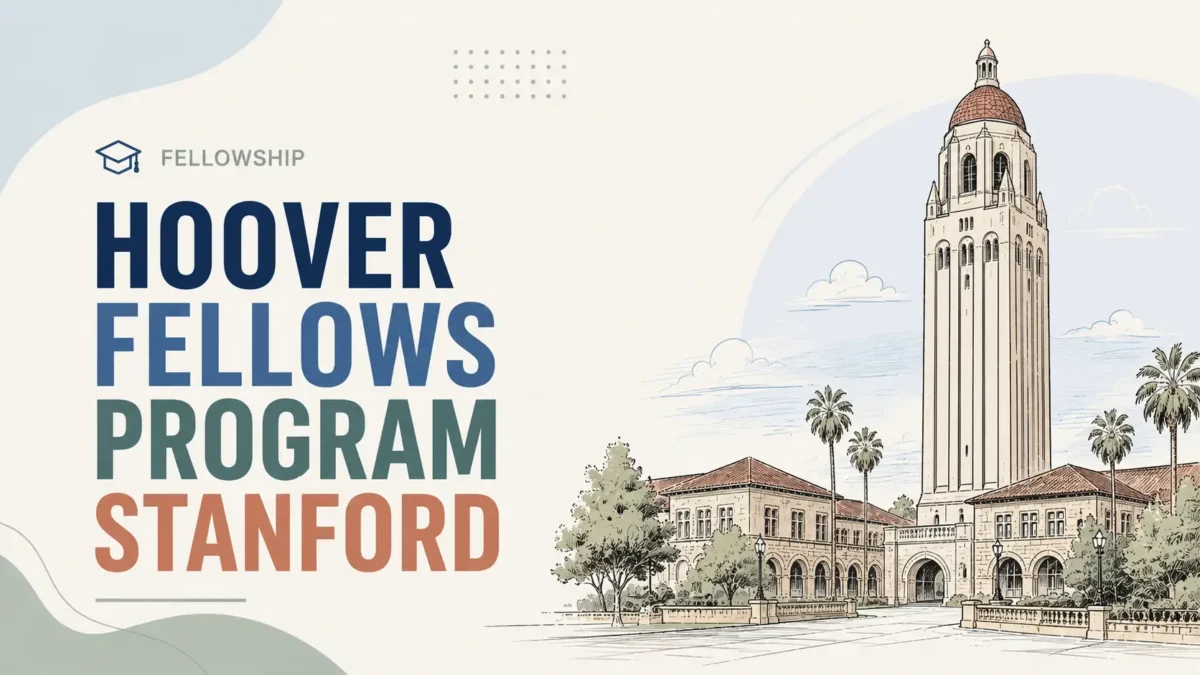
The Hoover Institution at Stanford University is accepting applications for its 2027 Hoover Fellows Program, an early-career scholarly appointment for researchers whose work has implications for public policy. The position carries no teaching requirement, allowing fellows to focus on research, writing and participation in the intellectual life of Hoover and Stanford.
The appointment can run from one to three years. The published 12-month base salary range is $169,950 to $230,000, plus a $20,000 annual housing allowance. Applications close on 17 November 2026 at 11:59 p.m. Pacific Time.
Hoover Fellows Program at a Glance
- Institution: Hoover Institution, Stanford University
- Location: Stanford, California
- Appointment: Hoover Fellow
- Term: 1 to 3 years
- Base salary: $169,950–$230,000 per year
- Housing allowance: $20,000 annually
- Teaching: No teaching responsibilities
- Application opened: 18 August 2026
- Deadline: 17 November 2026, 11:59 p.m. PT
What the Hoover Fellows Program Is For
The programme is designed for outstanding early-career scholars who are developing an independent research agenda with direct or indirect relevance to public policy.
Hoover Fellows are expected to publish scholarly articles and books and to contribute to the Institution’s research community. The appointment is therefore best understood as a research position rather than a training programme or short visiting fellowship.
No Teaching Requirement
One of the most attractive features is the absence of teaching responsibilities. Fellows can devote the appointment to research, publication and engagement with Hoover and Stanford scholars.
For an early-career academic, protected research time can be especially valuable for converting a dissertation into a book, launching a second major project, completing articles or building a research programme with policy relevance.
Relevant Academic Fields
Hoover lists examples including:
- Economics.
- History.
- International Relations.
- National Security.
- Political Science.
- Public Policy.
The wording is not necessarily limited to these labels. A researcher in law, technology policy, political economy, education, security studies or another adjacent area may have a credible fit if the work aligns with Hoover’s public-policy research environment.
PhD Requirement
Candidates must hold a PhD or equivalent degree in a relevant field, or expect to complete the degree by 1 September 2027.
This creates an opportunity for advanced doctoral candidates who will finish before the appointment year, as well as recent PhD graduates building an early independent research profile.
What Hoover Fellows Are Expected to Produce
The programme expects fellows to publish scholarly articles and books with implications for public policy.
That wording is important. An applicant should not submit a research plan that is academically interesting but disconnected from broader institutional, economic, social, historical, security or governance questions.
The research does not need to be a policy memo. It can remain rigorous academic scholarship, but the application should make clear why the work matters for how people understand public institutions, markets, conflict, governance, regulation or other policy-relevant systems.
Salary and Housing Support
The 12-month base salary range is $169,950 to $230,000. Hoover also provides a $20,000 annual housing allowance.
The salary range is unusually high compared with many postdoctoral or early-career academic fellowships. Applicants should remember that placement within the range is determined through the institution’s hiring process and should not assume the maximum salary.
Length of Appointment
The Hoover Fellow appointment can last between one and three years.
A multi-year term can provide enough time to develop a significant publication record and establish a durable independent research programme, rather than requiring the fellow to immediately begin another job search after one academic year.
Stanford Research Environment
Hoover Fellows are encouraged to engage with Stanford’s wider research community. The Hoover Institution is located on Stanford’s campus, giving fellows access to scholars and events across the University.
A strong applicant should think beyond the fellowship title and identify intellectual communities at Stanford that could strengthen the proposed work—departments, research centres, archives, workshops or faculty whose expertise intersects with the project.
Required Application Materials
The application requires:
- A cover letter or statement of interest describing academic background and experience.
- One or more recent publications, working papers or draft book chapters.
- A curriculum vitae.
- A statement of future research plans, maximum two pages.
- Three letters of recommendation addressing research accomplishments and future potential.
The Writing Sample Matters
Hoover allows applicants to submit recent publications, working papers or draft book chapters. Choose material that best demonstrates independent scholarly judgement, methodological strength and the relevance of your research agenda.
A famous co-authored publication may be less useful than a strong sole-authored working paper if the latter makes your own intellectual contribution much easier to assess.
How to Use the Two-Page Research Statement
Two pages is short. The statement should not attempt to summarise every project you have ever considered.
A useful structure is:
- The central question of your future research programme.
- Why the question matters academically and for public policy.
- The specific project or projects you would pursue at Hoover.
- The evidence, archives, data or methods you would use.
- The expected outputs.
- Why Hoover and Stanford are especially useful environments for the work.
The strongest statements normally communicate a coherent agenda rather than several unrelated paper ideas.
How to Write the Cover Letter
Use the cover letter to explain the trajectory that connects your doctoral work, publications and future research. Avoid simply repeating the CV.
If your dissertation produced multiple papers, explain the larger problem they address. If you are moving into a new field, explain why the transition follows logically from your existing expertise.
It is also useful to state what type of scholar you are becoming. Search committees need to understand the future research identity, not only the dissertation topic.
Recommendation Letters
Three recommendation letters are required, and Hoover asks that they address both research accomplishments and potential for future research.
Select referees who can discuss your intellectual independence in detail. A senior name is less valuable if the letter can only provide generic praise.
Give referees your research statement, CV and application deadline early enough for them to comment on the direction of your work rather than only past performance.
Who Is Likely to Be Competitive?
Competitive applicants are likely to show several of the following:
- A strong doctoral dissertation or equivalent research record.
- High-quality publications or advanced working papers.
- A clear independent research agenda.
- Strong methodological or archival skills.
- A credible connection between scholarship and public policy.
- Evidence that the proposed work can generate major publications.
- Potential to contribute to Hoover’s intellectual community.
What Not to Do
Avoid treating the programme as a general Stanford fellowship. The application should show why the Hoover Institution is the appropriate intellectual home.
Do not use the research statement as an extended biography, and do not fill it with broad claims about changing public policy without explaining the underlying research question.
Also avoid sending a writing sample that makes your individual contribution impossible to identify.
International Applicants
The public programme page does not set out a detailed visa-sponsorship policy. International candidates who meet the academic requirements should review Stanford’s current employment and immigration requirements before assuming that a particular visa route will be available.
Do not state in an application that sponsorship is guaranteed unless confirmed through the institution’s hiring process.
Application Timeline
- 18 August 2026: Application system opened.
- 17 November 2026: Application deadline at 11:59 p.m. Pacific Time.
- By 1 September 2027: Candidates who are still completing a PhD must have finished the degree.
How to Apply
Applications are submitted through the official Hoover Apply system. Candidates should upload the required materials and arrange for three recommendation letters to be submitted through the application process.
The deadline is 17 November 2026 at 11:59 p.m. Pacific Time.
Frequently Asked Questions
How much does the Hoover Fellows Program pay?
The published annual base salary range is $169,950–$230,000, plus a $20,000 annual housing allowance.
How long is the appointment?
The appointment can run from one to three years.
Does the fellowship include teaching?
No. Hoover states that the position carries no teaching responsibilities.
Can a current PhD candidate apply?
Yes, provided the PhD or equivalent degree is completed by 1 September 2027.
What documents are required?
A cover letter, CV, recent scholarly work, a research statement of up to two pages and three recommendation letters are required.