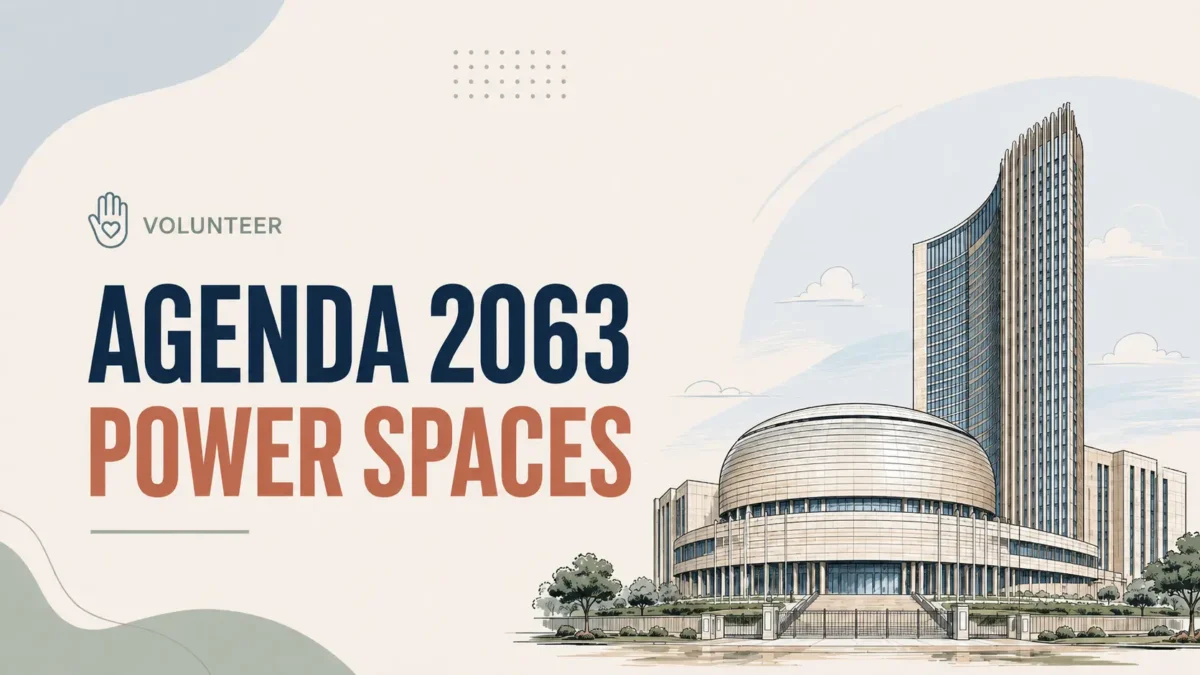
Applications are open for Agenda 2063 in Power Spaces – Cohort 3, a seven-week online leadership and volunteering programme hosted through the United Nations Volunteers platform with the United Nations Development Programme (UNDP). The current cohort is recruiting 500 Online Volunteers and is intended for people who want to connect their professional, academic, entrepreneurial or community work with Africa’s long-term development vision, Agenda 2063.
The programme is fully remote and requires an estimated 11–15 hours per week for seven weeks. It is important to understand the status correctly: this is an Online Volunteering assignment, not a paid UN Volunteer contract. UNV’s rules state that Online Volunteers do not receive a living allowance, salary or other financial benefits. Successful completion can lead to a certificate of appreciation or contribution through the UNV Online Volunteering system.
Cohort 3 at a Glance
- Host entity: United Nations Development Programme (UNDP)
- Platform: United Nations Volunteers (UNV) Unified Volunteering Platform
- Programme: Agenda 2063 in Power Spaces – Cohort 3
- Places: 500 Online Volunteers
- Format: Fully online
- Duration: 7 weeks
- Time commitment: Approximately 11–15 hours per week
- Assignment country: Ethiopia
- Participation location: Remote
- Compensation: Unpaid Online Volunteering
- Application deadline: 3 September 2026 on the UNV platform
What Agenda 2063 Means
Agenda 2063 is the African Union’s long-term framework for building “The Africa We Want”. It sets out aspirations for economic transformation, integration, peace, governance, cultural identity, people-driven development and a stronger global role for Africa.
The Power Spaces programme starts from the idea that continental goals are not delivered only by presidents, ministries or large institutions. They are also influenced through everyday environments where people make decisions and create value: businesses, universities, schools, community organisations, professional networks, development agencies, families, public institutions and civil-society groups.
Those environments are described as Power Spaces. The programme asks participants to identify the space they already influence and to become more intentional about how they use it.
This Is a Leadership Practice, Not Just an Agenda 2063 Course
Cohort 3 is structured as a seven-week leadership journey. The goal is not simply to memorise the African Union’s development aspirations. Participants are asked to produce practical leadership tools that link the continental vision with their own work and decisions.
The programme is built around seven tools: a Contribution Statement, Moonshot, Delivery plan, Leadership Values, Leadership Routines, a Letter from the Future and a Future Review.
Tool 1: Contribution Statement
The first step asks: What value do I create? Participants identify the practical contribution they already make, or could make, through their professional role, organisation, study, enterprise or community.
This is intended to move the participant from a general statement such as “I want Africa to develop” toward a clearer understanding of what they personally can influence.
Tool 2: Moonshot
The Moonshot asks participants to define a future that is ambitious enough to challenge the limits of present circumstances. The idea is to articulate a consequential outcome rather than a small short-term task.
A teacher, entrepreneur, civil servant, researcher or community organiser could all have different Moonshots, but each should connect to a real Power Space and to wider African transformation.
Tool 3: Delivery
The Delivery stage turns aspiration into change requirements. Participants identify what needs to shift between the present situation and the future they have described.
This can include capabilities, behaviours, institutions, partnerships, resources, policies or routines that need to change. The purpose is to avoid leadership plans that remain purely motivational.
Tool 4: Leadership Values
Participants identify the values that should guide difficult or consequential choices. The exercise asks not only what outcome they want, but what kind of leader they need to be while pursuing it.
Tool 5: Leadership Routines
The programme then focuses on repetition. Leadership Routines are actions that can be performed consistently enough to accumulate into meaningful results. This turns a one-time ambition into a sustained practice.
Tool 6: Letter from the Future
Participants write from the perspective of a future in which their intended contribution has succeeded. The exercise is designed to make the future more concrete and to expose choices that need to be made in the present.
Tool 7: Future Review
The final tool uses the cycle Return → Review → Revise → Recommit. Participants are encouraged to revisit their leadership portfolio after the formal seven-week programme rather than treating the cohort as a one-off training experience.
What Online Volunteers Will Actually Do
Selected volunteers will study the Agenda 2063 in Power Spaces Reader and supporting materials, take part in the weekly learning process, support participant engagement and contribute to small-group conversations where assigned.
They are expected to help participants connect the weekly tools to real Power Spaces instead of simply repeating course material. Volunteers will also contribute to a structured end-of-cohort review and provide feedback on what worked and what could improve future cohorts.
Who Is the Programme Looking For?
The opportunity is suitable for people with a strong interest in Agenda 2063, African development, leadership, public policy, business, education, community development or related fields.
UNV/UNDP messaging specifically points to a broad group of potential participants, including:
- Professionals and development practitioners.
- Researchers.
- Entrepreneurs.
- Educators.
- Students.
- Community leaders.
- People involved in public policy or social impact.
Applicants do not need to be experts on every part of Agenda 2063. Curiosity, critical engagement, communication and commitment to the full programme are more important than claiming specialist knowledge of the entire framework.
Skills and Qualities That Matter
Applicants should be able to read and engage critically with learning materials, communicate clearly in writing and conversation, provide concise constructive feedback and participate consistently over the full seven weeks.
The programme also benefits from people who can work across sectors and cultures. Small-group discussions are not intended to become lectures; volunteers should be able to listen, ask useful questions and help other participants connect the tools to their own context.
English Requirement
English is the working language for the assignment. Applicants should be comfortable reading programme materials and participating in written and spoken engagement in English.
Important: This Opportunity Is Unpaid
Online Volunteering through UNV is different from an onsite or contracted UN Volunteer assignment. UNV states that Online Volunteers are not under a contract with UNV or the engaging organisation, are not UN personnel and do not receive a Volunteer Living Allowance, salary or other financial compensation or benefits.
That distinction should be considered before applying. The value of this opportunity is the structured leadership experience, contribution to a UNDP-hosted initiative, interaction with other participants and the potential UNV certificate after successful completion—not financial support.
What You Can Take Away
Participants are expected to finish the programme with a personal leadership portfolio rather than just a completion record. That portfolio can include the Contribution Statement, Moonshot, delivery priorities, values, routines and future-oriented reflections developed throughout the seven weeks.
For people working in development, public service, research, entrepreneurship or community leadership, these tools can provide a structured way to connect day-to-day work with a longer-term African development agenda.
How to Make a Strong Application
The application should show that you already have a Power Space, even if it is not a formal leadership position. A student may influence a university community; an entrepreneur may shape a local market; a teacher may influence learning outcomes; a researcher may contribute evidence; a community organiser may mobilise people; and a professional may change practices inside an organisation.
Explain the context where you currently create value, why Agenda 2063 matters to that context and what you hope to strengthen through the cohort. Avoid a generic motivation statement made entirely of phrases such as “I am passionate about leadership.” Concrete examples of contribution, collaboration or community engagement are more useful.
Time Commitment
The current cohort calls for approximately 11–15 hours per week for seven weeks. Applicants should treat that as a real commitment. If work, classes or another programme make it difficult to participate consistently, consider the schedule before applying.
How to Apply
Applications are submitted through the official UNV Unified Volunteering Platform. Candidates need a UNV account/profile and should complete the application for the Cohort 3 assignment listed under UNDP.
The current listing closes on 3 September 2026 according to the UNV assignment feed. Because the platform can display deadlines according to timezone, applicants should rely on the exact closing time shown in their own UNV account and submit earlier rather than waiting for the last day.
Frequently Asked Questions
Is UNDP Agenda 2063 in Power Spaces Cohort 3 paid?
No. It is an Online Volunteering assignment. UNV Online Volunteers do not receive salary, living allowance or other financial compensation.
How many participants are being recruited?
Official UNV communications for Cohort 3 state that 500 Online Volunteers are being recruited.
Is the programme remote?
Yes. The assignment is online and can be completed remotely.
How much time does it require?
The current cohort indicates approximately 11–15 hours per week for seven weeks.
Do I need to be an Agenda 2063 expert?
No. The assignment specifically emphasises curiosity, disciplined engagement, communication and the willingness to help others translate the tools into their own contexts.